
 Image 1 of 4
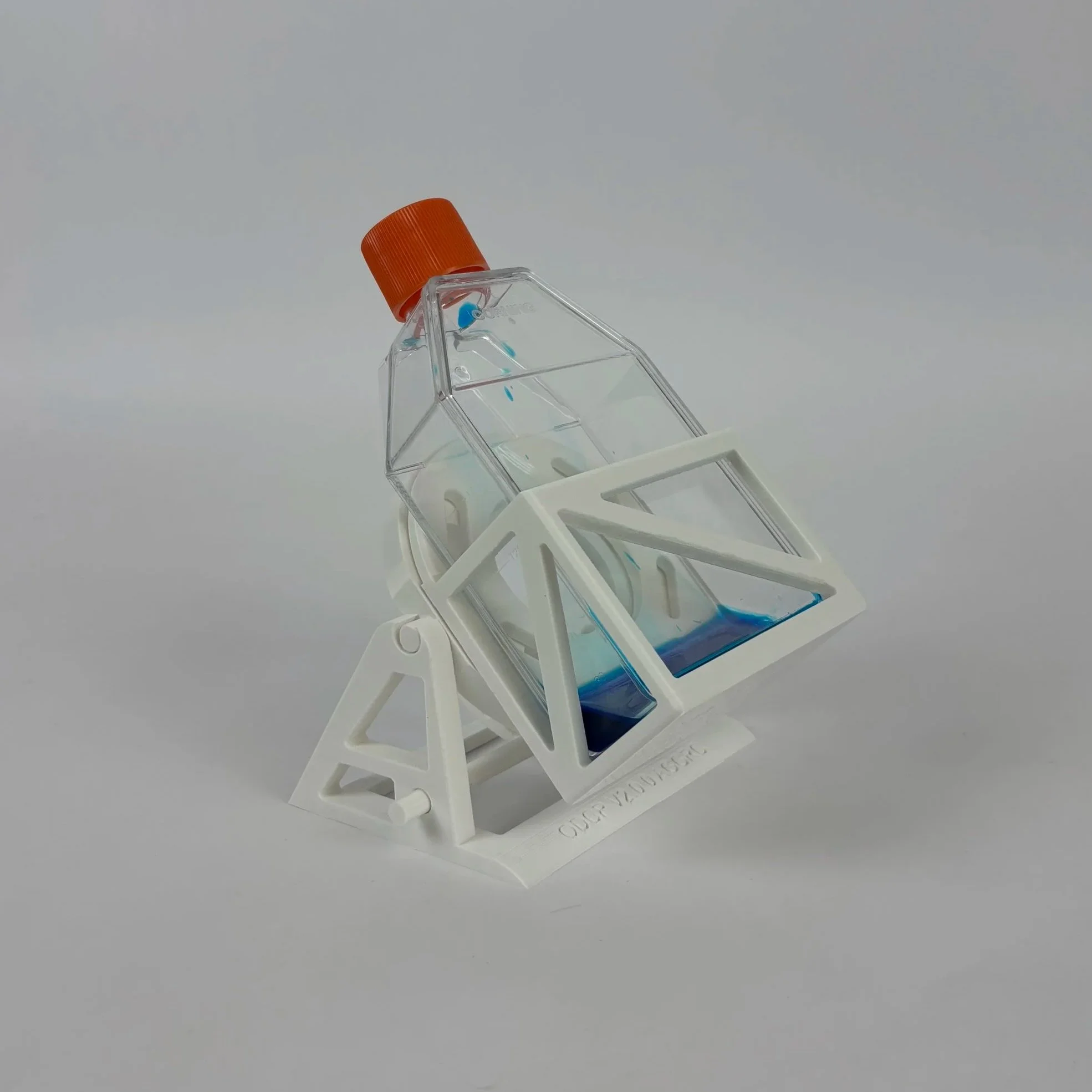 Image 2 of 4
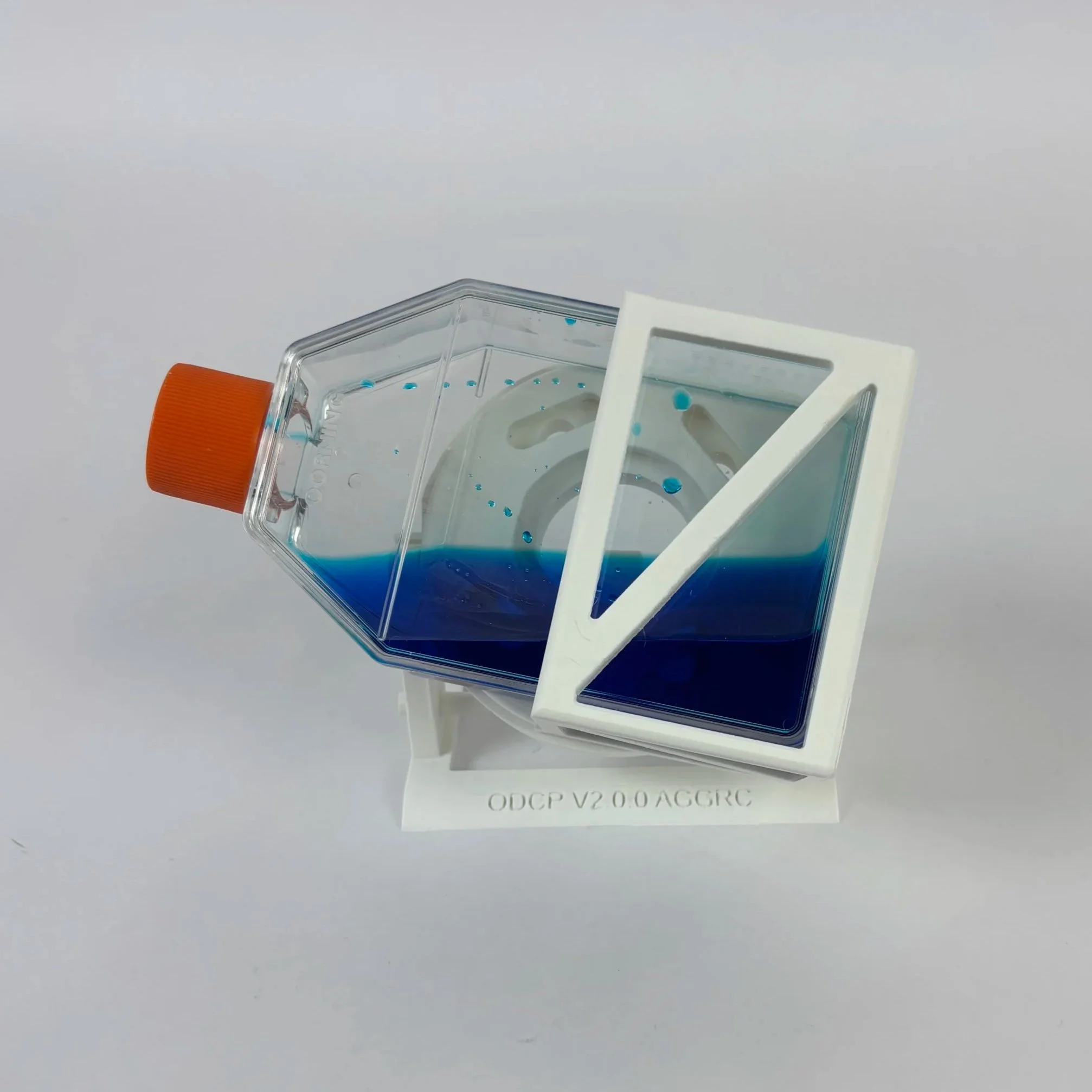 Image 3 of 4
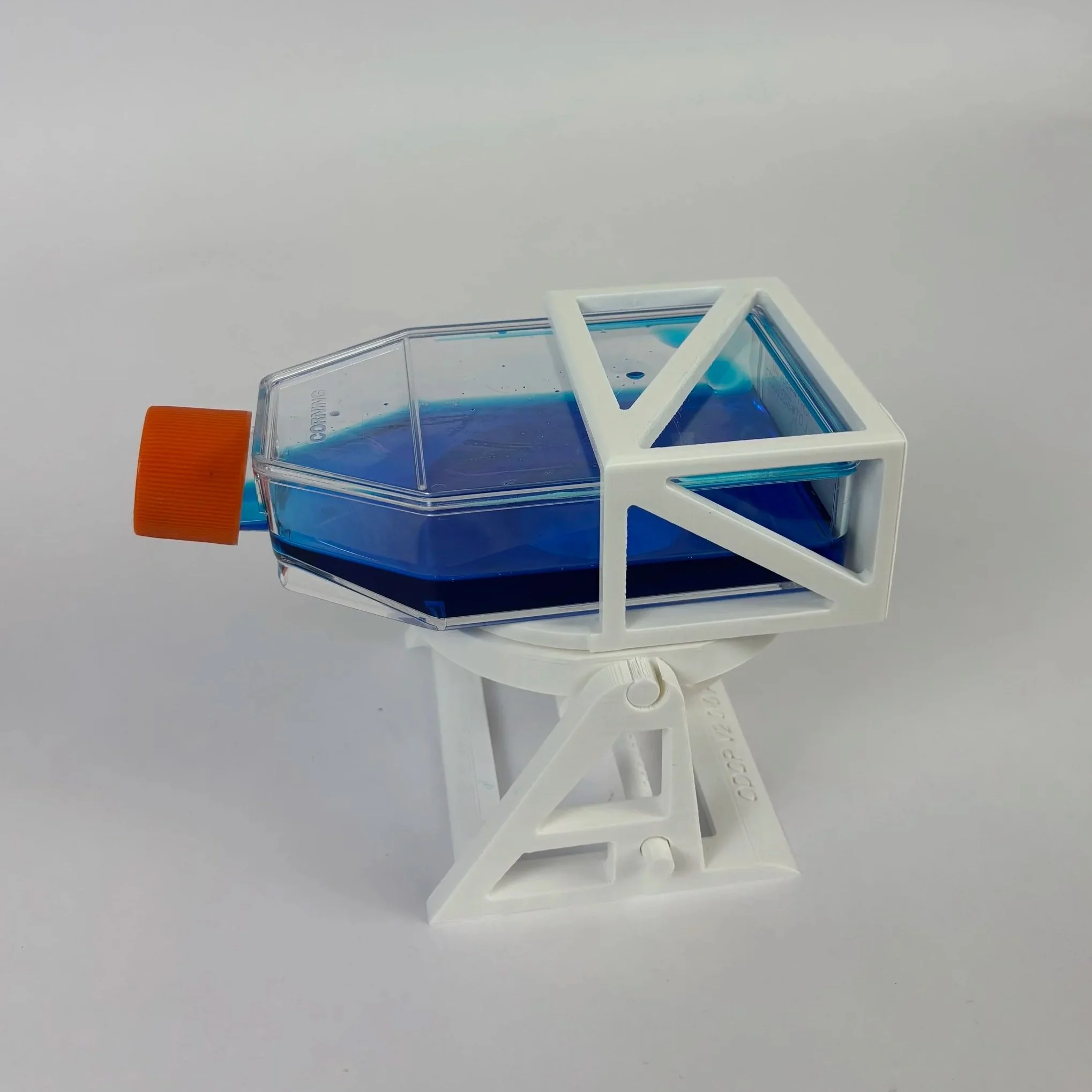 Image 4 of 4
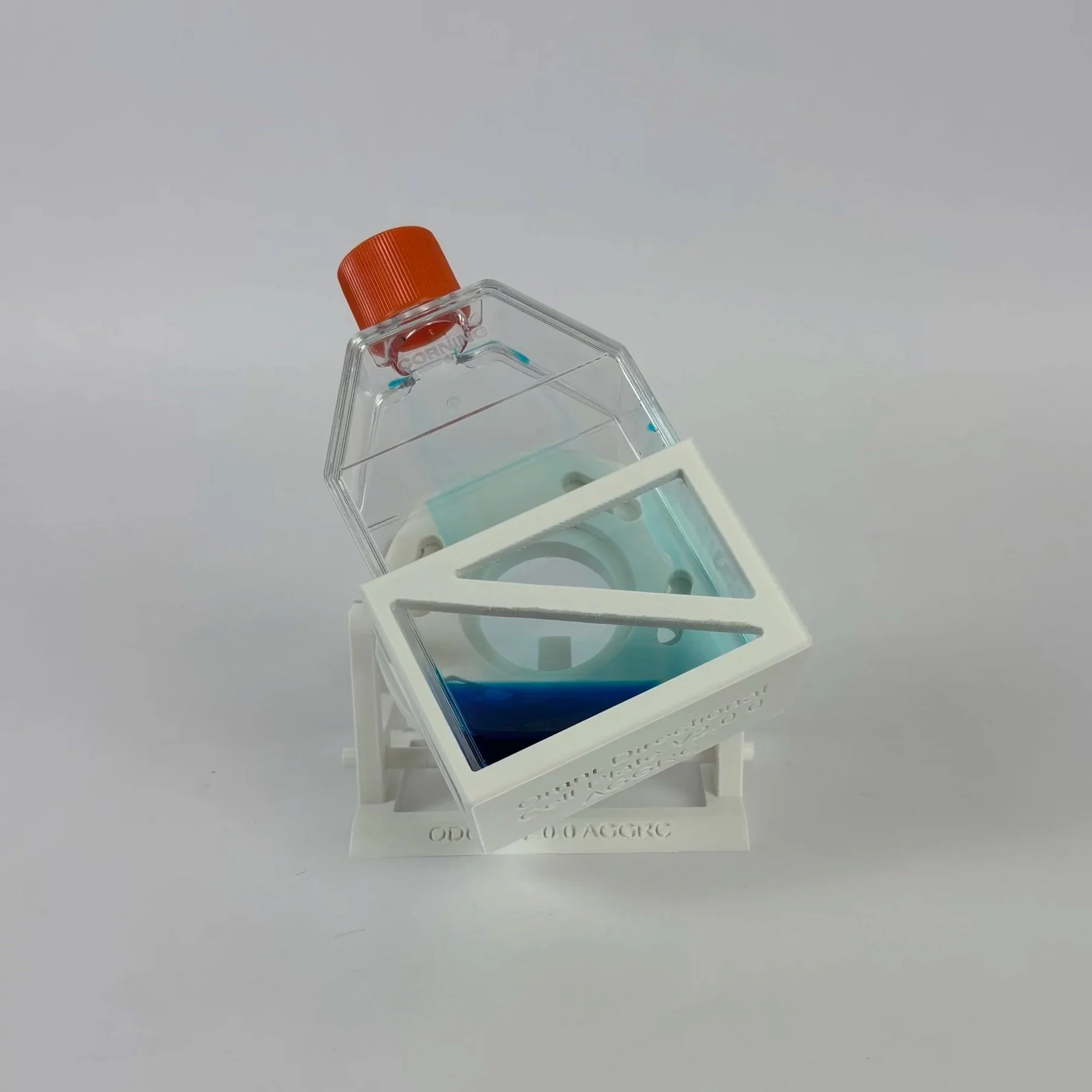
The purpose of the Omni-Directional Cell Plate (ODCP) is to facilitate early, middle, and late-stage growth of cells by tilting a cell culture flask. Based upon how the flask is tilted it changes the surface area distribution of the cell culture media. The design includes rotation points on the x-axis and y-axis to allow for a range of custom settings that fit user needs. In early-stage development the media is isolated to a single corner of the flask allowing for optimal growth. As the cells grow the user can decrease the angle of the tilt for later development, and when the flask begins reaching capacity the ODCP can be stored in a standard flat position.
Developed by the Aquatic Germplasm Center of Research Excellence (AGCoRE) and Aquatic Germplasm and Genetic Resources Center (AGGRC) at the Louisiana State University Agricultural Center. Designed by Stephen Rice under the guidance of Jack Koch. Honore Miguel Simo Tengwo made original contributions. This work was funded in part by the National Science Foundation (Award: 2319783) in partnership with the University of Alabama Birmingham and the National Institutes of Health Office of Research Infrastructure Programs (Awards: R24-OD028443, R24-OD037797, R24-OD034058).
Please visit AGGRC.com to learn more about our work. Feedback on our device can be provided by emailing us at aggrc@agcenter.lsu.edu or by filling out or feedback form: https://forms.cloud.microsoft/r/sgBh4A8tXe
Detailed Description: The ODCP V2.0.0 design consists of four interlocking parts, and those are: the basket, the rotator, the base, and the pin. The basket holds the cell culture flask with two open sides to allow for easy insertion and cell culture visibility. The back of the basket has two protruding pins that go into holes that are on the rotator. The holes on the rotator are separated in a circular pattern that allows the user to take the pins and insert them at one of the pre-selected angles, providing the first axis of rotation. The rotator has an axle running through the center of it, and this snaps into the holes located on top of the base, providing the second axis of rotation. There is a half-circle with holes on the underside of the rotator that locks the system into place when the pin is slotted into the hole on the bottom of the base and the hole on this half-circle. When all components are combined they provide a stable, interlocking, and customizable structure to facilitate cell growth.
The purpose of the Omni-Directional Cell Plate (ODCP) is to facilitate early, middle, and late-stage growth of cells by tilting a cell culture flask. Based upon how the flask is tilted it changes the surface area distribution of the cell culture media. The design includes rotation points on the x-axis and y-axis to allow for a range of custom settings that fit user needs. In early-stage development the media is isolated to a single corner of the flask allowing for optimal growth. As the cells grow the user can decrease the angle of the tilt for later development, and when the flask begins reaching capacity the ODCP can be stored in a standard flat position.
Developed by the Aquatic Germplasm Center of Research Excellence (AGCoRE) and Aquatic Germplasm and Genetic Resources Center (AGGRC) at the Louisiana State University Agricultural Center. Designed by Stephen Rice under the guidance of Jack Koch. Honore Miguel Simo Tengwo made original contributions. This work was funded in part by the National Science Foundation (Award: 2319783) in partnership with the University of Alabama Birmingham and the National Institutes of Health Office of Research Infrastructure Programs (Awards: R24-OD028443, R24-OD037797, R24-OD034058).
Please visit AGGRC.com to learn more about our work. Feedback on our device can be provided by emailing us at aggrc@agcenter.lsu.edu or by filling out or feedback form: https://forms.cloud.microsoft/r/sgBh4A8tXe
Detailed Description: The ODCP V2.0.0 design consists of four interlocking parts, and those are: the basket, the rotator, the base, and the pin. The basket holds the cell culture flask with two open sides to allow for easy insertion and cell culture visibility. The back of the basket has two protruding pins that go into holes that are on the rotator. The holes on the rotator are separated in a circular pattern that allows the user to take the pins and insert them at one of the pre-selected angles, providing the first axis of rotation. The rotator has an axle running through the center of it, and this snaps into the holes located on top of the base, providing the second axis of rotation. There is a half-circle with holes on the underside of the rotator that locks the system into place when the pin is slotted into the hole on the bottom of the base and the hole on this half-circle. When all components are combined they provide a stable, interlocking, and customizable structure to facilitate cell growth.